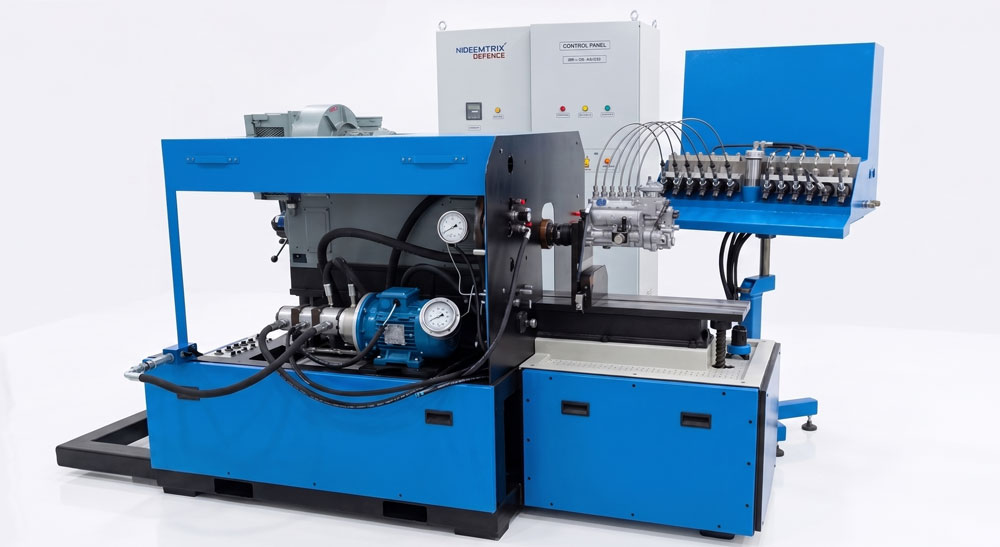

Modern diesel engines — whether in commercial trucks meeting Euro VI emissions standards on European motorways, military vehicles in desert operations, naval vessels, or industrial generators — deliver their performance, efficiency, and emissions compliance through the precision of their fuel injection systems. A fuel injection pump that delivers slightly more fuel than calibrated produces increased emissions and higher fuel consumption. An injector with a worn spray pattern produces incomplete combustion, increased particulate output, and power loss. Neither problem is visible externally. Both are revealed on a test rig.
A multipurpose fuel injection pump and injector test rig is the equipment that calibrates, diagnoses, and verifies fuel injection system components across a range of diesel engine types — from traditional inline pump systems in older military vehicles through modern common rail high-pressure injection in current Euro VI commercial engines.
What Fuel Injection Testing Actually Measures
Injection timing: The crank angle at which injection begins relative to top dead centre determines combustion phasing — too early (advance) causes knocking and NOx; too late (retard) causes smoke and fuel consumption increase. Injection timing is set and verified on the test bench to the manufacturer’s specification for each engine type and load condition.
Volumetric delivery: The volume of fuel injected per stroke at defined test conditions must match the calibration specification. Even small delivery errors — 2–3% at full load — produce measurable differences in power and emissions. For multiple-cylinder pump units, delivery balance between cylinders is equally important; imbalanced delivery causes uneven cylinder loading and vibration.
Spray pattern and atomisation: Injector nozzles produce a cone-shaped spray of fine fuel droplets. The spray cone angle, droplet size distribution, and symmetry of the pattern affect combustion quality. Worn or carbonised nozzles produce asymmetric sprays with larger droplets — poor atomisation leads to incomplete combustion, smoke, and increased fuel consumption. Spray testing on the bench identifies nozzle condition before the injector is returned to the engine.
Opening pressure (crack pressure): The pressure at which the injector needle opens against its spring load. Too low: fuel leaks past the needle at low pressure, contaminating combustion chamber with unburned fuel. Too high: injection is delayed and the delivery characteristics change. Setting and verifying opening pressure is a basic injector test bench function.
Common rail injector characterisation: Modern common rail diesel injection systems (Bosch, Delphi, Denso) use piezoelectric or solenoid-controlled injectors operating at rail pressures from 1,600 to 2,500 bar. These injectors require specialised test benches with high-pressure common rail simulation capability — standard pump test benches designed for older injection systems cannot adequately test common rail components.
Military Vehicle Applications
The diesel engines in military vehicles — from light protected patrol vehicles (PPV) through heavy logistic trucks to armoured fighting vehicles — face harsh operating conditions: extreme temperatures, dusty environments, high idle times, and extended service intervals. Their fuel injection systems require periodic calibration and maintenance.
UK Ministry of Defence vehicle maintenance (REME, Royal Electrical and Mechanical Engineers) and equivalent organisations in NATO nations maintain fuel injection test bench capability at repair facilities. NATO STANAG-compliant maintenance procedures reference injection pump calibration specifications for the range of diesel engines in their vehicle fleets — from the MTU engines in Challenger tanks to the common rail diesel systems in FMTV trucks.
European Emissions Standards and Test Requirements
Euro VI (and its equivalent US EPA 2010 standard) requires diesel engines in commercial vehicles to meet very stringent NOx and particulate matter limits. Achieving these limits depends critically on the injection system delivering the correct quantity, timing, and spray characteristics. Euro VI emission system maintenance includes injector and pump inspection and calibration at defined service intervals, with results documented against the vehicle’s emission compliance record. In the UK, MOT testers and fleet operators use test equipment to verify injection system performance as part of emissions compliance management.
Neometrix Multipurpose Fuel Injection Pump & Injector Test Rig
A versatile test bench covering traditional inline and distributor injection pumps, unit injectors, and common rail injector systems for diesel engines across military, commercial, and industrial applications. Measures injection timing, volumetric delivery, spray pattern, crack pressure, and common rail high-pressure delivery characteristics.
→ View Full Specifications
→ Request a Quote
FAQ
Q: What is injection timing and why does it need to be tested on a bench?
A: Injection timing is the point in the engine’s compression stroke — expressed as degrees of crankshaft rotation before top dead centre — when fuel injection begins. Correct timing optimises the combustion event for power, efficiency, and emissions. A pump with timing outside specification produces a measurable change in engine behaviour — slightly early timing increases NOx and can cause knock; late timing increases smoke (unburned carbon particulates) and fuel consumption. Timing cannot be reliably set or verified while the pump is installed on the engine; the test bench allows precise measurement and adjustment under controlled, repeatable conditions.
Q: What is common rail diesel injection and how does it differ from traditional pump testing?
A: Common rail systems use a high-pressure pump to pressurise a common fuel rail at 1,600–2,500 bar, with individual electronically controlled injectors drawing from this common rail for each injection event. This allows multiple injection events per cycle (pilot, main, post injection), precise control of injection quantity and timing, and variable injection pressure optimised for each operating point. Testing common rail injectors requires simulating the high rail pressure (up to 2,500 bar), electronically triggering the injector at the correct pulse width and frequency, and measuring the resulting fuel delivery with precision flow measurement. Traditional pump test benches designed for mechanical inline pumps at 600–1,200 bar cannot simulate these conditions.
Neometrix Defence Ltd. designs and manufactures fuel injection pump and injector test rigs for military vehicle maintenance, commercial fleet service, and industrial diesel applications. [email protected] | +91-7777-876-876