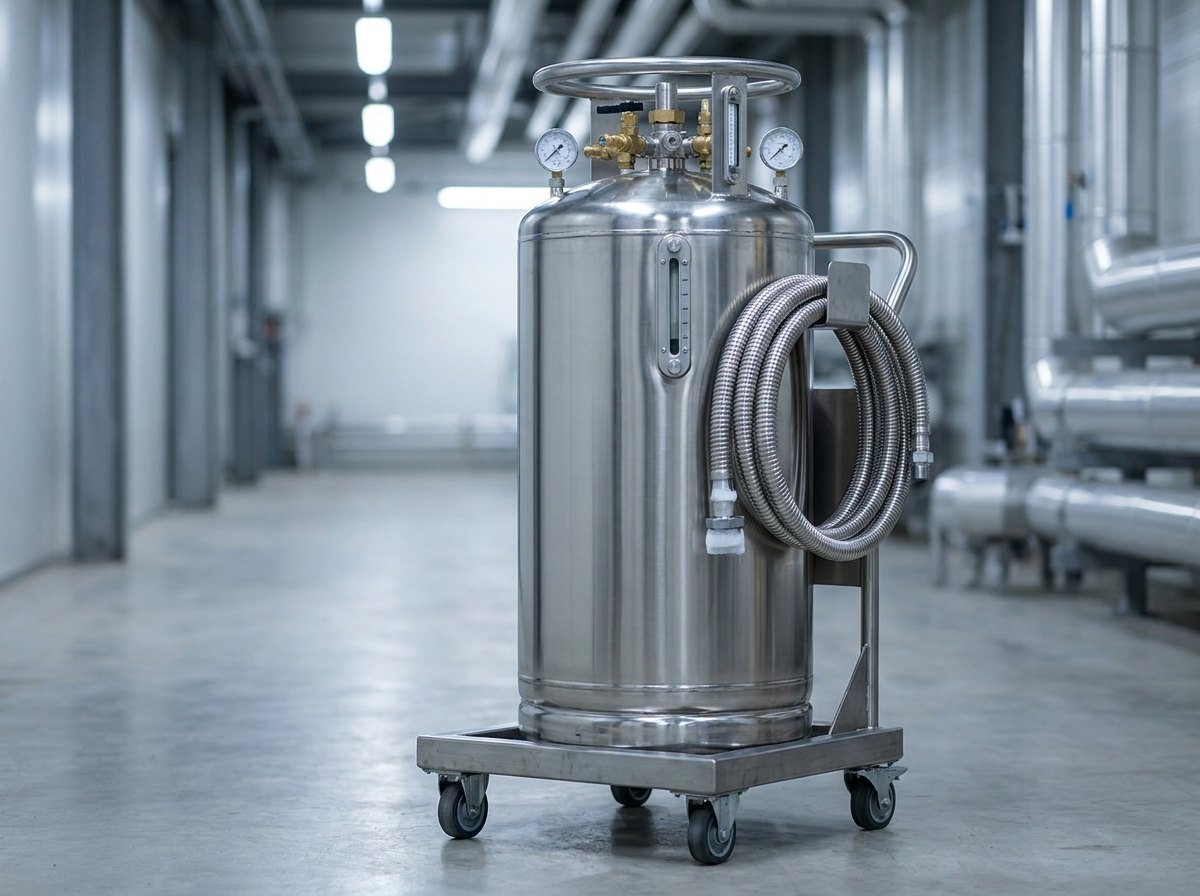

Liquid nitrogen — nitrogen cooled to -196°C, at which point it liquefies at atmospheric pressure — is one of the most widely used cryogenic fluids in laboratories, hospitals, food processing, aerospace, and industrial applications. Its abundance, relatively low cost, and the fact that nitrogen comprises 78% of atmospheric air (making it easily recoverable) make it the cryogenic fluid of choice wherever cold temperatures are needed without the explosion hazard of liquid hydrogen or the expense and supply scarcity of liquid helium.
Storing and transporting liquid nitrogen in practical quantities requires specialised containers — Dewar flasks, named after Sir James Dewar who developed the double-walled evacuated vessel in the 1890s — that maintain the liquid at -196°C in an ambient-temperature environment through the engineering principle of high-vacuum insulation.
How a Dewar Flask Works
A Dewar flask is a double-walled container with the space between the inner and outer walls evacuated to a high vacuum (typically better than 10⁻⁴ mbar). Heat transfer between the inner vessel (at -196°C) and the outer vessel (at ambient temperature) can occur by three mechanisms: conduction, convection, and radiation. The vacuum eliminates conduction and convection between the walls almost completely — no gas molecules means no molecular heat transfer. Radiation heat transfer (infrared) is reduced but not eliminated; the inner and outer walls are polished to a mirror finish to maximise infrared reflectivity. The combination of high vacuum and reflective walls achieves a heat leak small enough that liquid nitrogen boil-off rates are commercially acceptable.
Boil-off rate is the key performance parameter — the mass of liquid nitrogen lost per day as it absorbs the residual heat leak and vaporises. Typical portable Dewar containers have boil-off rates of 0.5–2% per day of the rated capacity, depending on size and insulation quality. A 50-litre Dewar losing 1% per day loses approximately 0.5 litres per day — acceptable for most applications.
Pressure and Venting
Liquid nitrogen at -196°C is at atmospheric pressure. As it warms even slightly, nitrogen vaporises and pressure builds. A sealed container with no venting would build pressure continuously until it either reaches the pressure relief valve set point or fails structurally. All liquid nitrogen Dewars include a pressure relief valve that opens to vent nitrogen vapour when internal pressure reaches the set point — typically 50–175 mbar above atmospheric for open neck designs, or 1.5–3 bar for pressurised withdrawal designs.
Proper venting is essential. A Dewar stored in an unventilated enclosed space will progressively enrichen the atmosphere with nitrogen vapour from normal boil-off and pressure relief events. Nitrogen enrichment above approximately 96% (corresponding to oxygen below approximately 4%) causes loss of consciousness without warning — there is no smell, no irritation, no precursor signal. Asphyxiation in nitrogen-enriched atmospheres is one of the most common industrial fatality types in facilities that use cryogenic nitrogen. The BCGA (British Compressed Gases Association) CP30 Code of Practice covers safe handling of cryogenic fluids in the UK; CGA P-12 is the equivalent US guidance from the Compressed Gas Association.
Pressure Reducing Panel Integration
Many applications — laboratory gas systems, aerospace cryogenic testing, medical gas supply — require liquid nitrogen to be withdrawn from the Dewar as gas at a controlled pressure rather than as liquid. A Pressure Reducing Panel (PRP) connected to the Dewar’s vapour withdrawal valve allows liquid nitrogen to be vaporised in the Dewar’s built-in vaporiser or in an external vaporiser, and the resultant gaseous nitrogen delivered to the distribution system at the required pressure. The PRP regulates pressure from the Dewar working pressure down to the distribution system working pressure with appropriate safety relief downstream.
Applications
Aerospace and defence cryogenic testing: Environmental test chambers that cycle aircraft components through temperature ranges including sub-zero require liquid nitrogen as the coolant source. Aerospace and defence test facilities across the UK (QinetiQ, Thales UK, BAE Systems), continental Europe, and the USA use portable Dewars connected to test chamber cryogenic circuits.
Medical and biological: Cryopreservation of biological samples, cellular products, and reproductive materials in hospitals, fertility clinics, and biobanks across the UK, Europe, and the Middle East requires reliable liquid nitrogen supply with precisely specified storage temperatures. The NHS and private hospital sector in the UK is a substantial consumer of liquid nitrogen Dewars.
Food processing: Cryogenic food freezing using liquid nitrogen injection is used in food manufacturing across the UK, Europe, and the Gulf to rapidly freeze products without ice crystal damage.
Laboratory research: Universities, pharmaceutical research facilities, and commercial laboratories across all regions use liquid nitrogen for sample storage, low-temperature chemistry, and materials characterisation.
Neometrix Portable Liquid Nitrogen Container (Dewar) with Pressure Reducing Panel
Vacuum-insulated portable liquid nitrogen storage containers with integrated or separate pressure reducing panels for gaseous nitrogen withdrawal at controlled pressure. Safe handling design per BCGA CP30 and CGA P-12. Available in multiple capacity configurations for laboratory, industrial, and aerospace applications.
→ View Full Specifications
→ Request a Quote
FAQ
Q: How long does liquid nitrogen last in a portable Dewar container?
A: It depends on the container size, the insulation quality, and how often the container is opened. Typical portable Dewars have boil-off rates of 0.5–2% of capacity per day from the background heat leak alone. A well-insulated 50-litre Dewar losing 1% per day would hold its full charge for approximately 100 days if undisturbed — but normal use (withdrawing liquid or gas) adds to consumption. Liquid withdrawal is more efficient than gas withdrawal for high-consumption applications. Containers with higher vacuum quality and larger size-to-surface-area ratios have lower percentage boil-off rates.
Q: Why is liquid nitrogen dangerous in enclosed spaces and what precautions are needed?
A: Liquid nitrogen vaporises continuously through normal boil-off and relief venting. Nitrogen gas is colourless, odourless, and non-toxic, but it displaces oxygen. In an enclosed space with inadequate ventilation, nitrogen accumulation reduces oxygen concentration — at below approximately 19.5% oxygen (atmospheric is 20.9%), dizziness and impaired judgement begin. Below approximately 16%, loss of consciousness can occur without warning. Below 6%, death follows rapidly. There is no sensory warning — no smell, no irritation. UK guidance (BCGA CP30) requires adequate ventilation wherever liquid nitrogen is handled or stored, oxygen monitors in areas at risk, and confined space entry procedures for any enclosed space where significant nitrogen volumes are present.
Neometrix Defence Ltd. supplies portable liquid nitrogen Dewar containers for aerospace, laboratory, medical, and industrial cryogenic applications. [email protected] | +91-7777-876-876