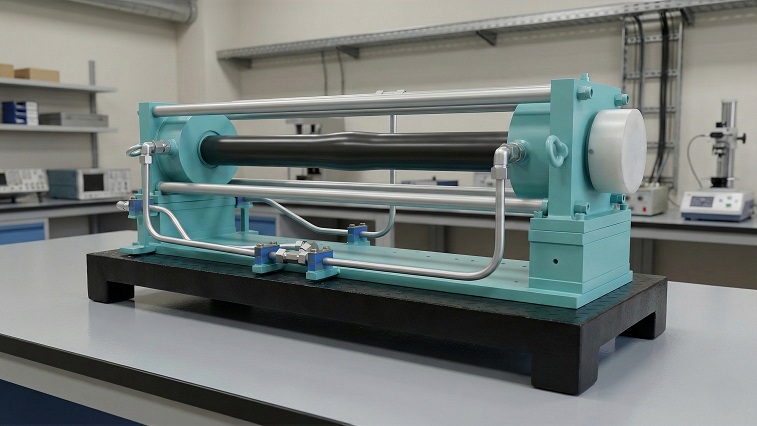

Metallic tubes are the arteries of hydraulic, pneumatic, fuel, and process systems in aerospace, power generation, oil and gas, and nuclear applications. They carry fluids at pressures from tens of bar to hundreds of bar, through temperature cycles from cryogenic to several hundred degrees Celsius, under vibration and mechanical loads. A tube that fails in service in any of these applications — whether by burst, fatigue crack, or leak — creates a safety hazard or operational failure of the system it serves.
A tube pressurization test setup subjects tubes to controlled high-pressure and high-temperature conditions — beyond their rated operating conditions — to verify they meet yield strength, burst pressure, leak integrity, and fatigue life requirements before installation in critical systems.
What a Tube Pressurization Test Setup Does
Hydrostatic pressure testing: Filling the tube with liquid (typically water or hydraulic oil) and pressurising to proof pressure (typically 1.5× operating pressure) to verify structural integrity without permanent deformation or leakage. The liquid medium minimises stored energy compared to pneumatic testing, reducing hazard severity in the event of failure.
Burst pressure testing: Pressurising to failure to determine the ultimate pressure capacity of the tube, for design validation and safety factor confirmation. Results establish the actual safety margin relative to operating and proof pressures.
Cyclic fatigue testing: Repeatedly pressurising and depressurising between specified limits for a defined number of cycles, simulating service life pressure cycling to verify fatigue life requirements.
Proof pressure testing: Single-event overload testing at 1.5–2× rated pressure with a defined hold time, verifying the tube passes without permanent deformation or leakage — the standard production acceptance test for safety-critical tube assemblies.
Thermal pressure testing: Applying pressure while the tube is at elevated temperature, characterising how material strength and creep behaviour under pressure evolve with temperature.
Equipment Architecture
Haskel air-driven intensifier pump: The Haskel pump uses compressed air to drive a pressure amplifier, generating high hydraulic pressure (up to 414 bar in this configuration) from a standard shop air supply. No high-pressure hydraulic infrastructure required — the intensifier is self-contained and portable.
WIKA pressure instrumentation: WIKA gauges and pressure transducers provide high-accuracy pressure measurement throughout the test, with calibration traceable to national standards. For aerospace and nuclear applications, traceable calibration certificates are required for all test instrumentation.
PID-controlled heater blocks: For thermal-pressure testing, heater blocks with PID temperature control and thermocouple feedback maintain precise, uniform temperature distribution along the test tube.
PLC/DAQ integration: Automated test sequences, real-time pressure and temperature monitoring, programmatic ramp rates, hold times, and data logging. Optional LabVIEW or Chant DataTEST integration for advanced data analysis.
Safety enclosure: Burst testing creates energetic failure events. A safety chamber or blast shield protects the operator, with interlocks preventing access during pressurised conditions.
Key Specifications
| Parameter | Specification |
|---|---|
| Tube length | Up to 3,965 mm |
| Tube diameter | 6 mm to 32 mm |
| Test pressure range | 1–414 bar |
| Test media | Water (heated to 65°C ± 5°C) or hydraulic oil |
| Pressure accuracy | ±5% |
| Heater temperature | Up to rated test temperature |
International Standards
| Standard | Application |
|---|---|
| ASME B31.1 | Power piping — pressure testing requirements |
| ASME B31.3 | Process piping — hydrostatic and pneumatic testing |
| EN 12952 | Water-tube boilers — pressure testing |
| ISO 1402 | Rubber and plastics hoses — hydrostatic testing |
| SAE AS4395 | Aerospace tube assemblies — pressure testing |
| ASTM A450 | Steel tubes — general requirements including pressure testing |
Applications
Aerospace hydraulic lines: Aircraft hydraulic tube assemblies — from fuselage root to actuator — require proof pressure testing before installation. SAE AS4395 specifies the test requirements. The Neometrix tube test setup handles tube lengths up to 3,965 mm and diameters 6–32 mm, covering the range of aircraft hydraulic tubing.
Power generation: Boiler tubes, superheater tubes, and heat exchanger tubes in steam power plants require hydrostatic testing per ASME B31.1 or EN 12952. High-temperature pressure testing characterises tube behaviour at operating conditions.
Oil and gas: Process piping and instrument tubing in upstream and downstream oil and gas require pressure testing per ASME B31.3 before commissioning.
Nuclear: Instrumentation tubes and process lines in nuclear facilities require proof pressure testing with full NIST-traceable calibration documentation.
Neometrix Tube Pressurization Test Setup
A purpose-built turnkey system for rigorous validation of metallic tubes under combined high-pressure and high-temperature conditions. Haskel air-driven intensifier to 414 bar, WIKA instrumentation, PID-controlled heaters, PLC/DAQ automation with optional LabVIEW integration, and safety enclosure. Handles tube lengths to 3,965 mm, diameters 6–32 mm.
→ View Full Specifications
→ Request a Quote
FAQ
Q: Why is hydrostatic testing preferred over pneumatic testing for tube pressure validation?
A: Liquids (water, hydraulic oil) are nearly incompressible — the stored energy in a pressurised liquid system is a small fraction of that in an equivalent pneumatic system. If a tube bursts during hydrostatic testing, the failure releases the stored elastic energy in the liquid and tube walls, but not the volumetric expansion energy of a compressible gas. Pneumatic testing stores vastly more energy — a tube burst under pneumatic test conditions can create a high-velocity shrapnel event. Hydrostatic testing is standard for pressure testing of tubes, vessels, and piping precisely because the hazard severity of failure during the test is much lower.
Q: What is a Haskel pump and why is it used for tube pressure testing?
A: A Haskel pump is an air-driven pressure intensifier — a differential-area piston device that amplifies compressed air pressure (typically 6–10 bar) to high hydraulic pressure (up to several thousand bar depending on the ratio). For tube pressurization test setups, Haskel pumps provide a compact, portable high-pressure source without requiring a dedicated high-pressure hydraulic power unit. They deliver accurate, controllable pressure ramp and hold capability through needle valve metering, and are widely used in aerospace and industrial tube testing because of their reliability, simplicity, and available pressure range.
Q: What is proof pressure testing and when is it required?
A: Proof pressure testing applies a single overload pressure — typically 1.5× maximum operating pressure — held for a defined period (commonly 10 minutes), then released. The tube is inspected for permanent deformation and checked for leakage. Proof testing is required for production acceptance of safety-critical tube assemblies in aerospace (SAE AS4395), power generation (ASME B31.1), and nuclear applications. It verifies that every tube in a production batch meets the minimum structural and seal integrity requirements before installation, complementing design qualification burst testing which is performed only on representative samples.
Neometrix Defence Ltd. manufactures tube pressurization test setups for aerospace, power generation, oil and gas, and nuclear tube validation. [email protected] | +91-7777-876-876