How Ammunition Manufacturers Reduce Rejection Rates with Automated Pressure Testing
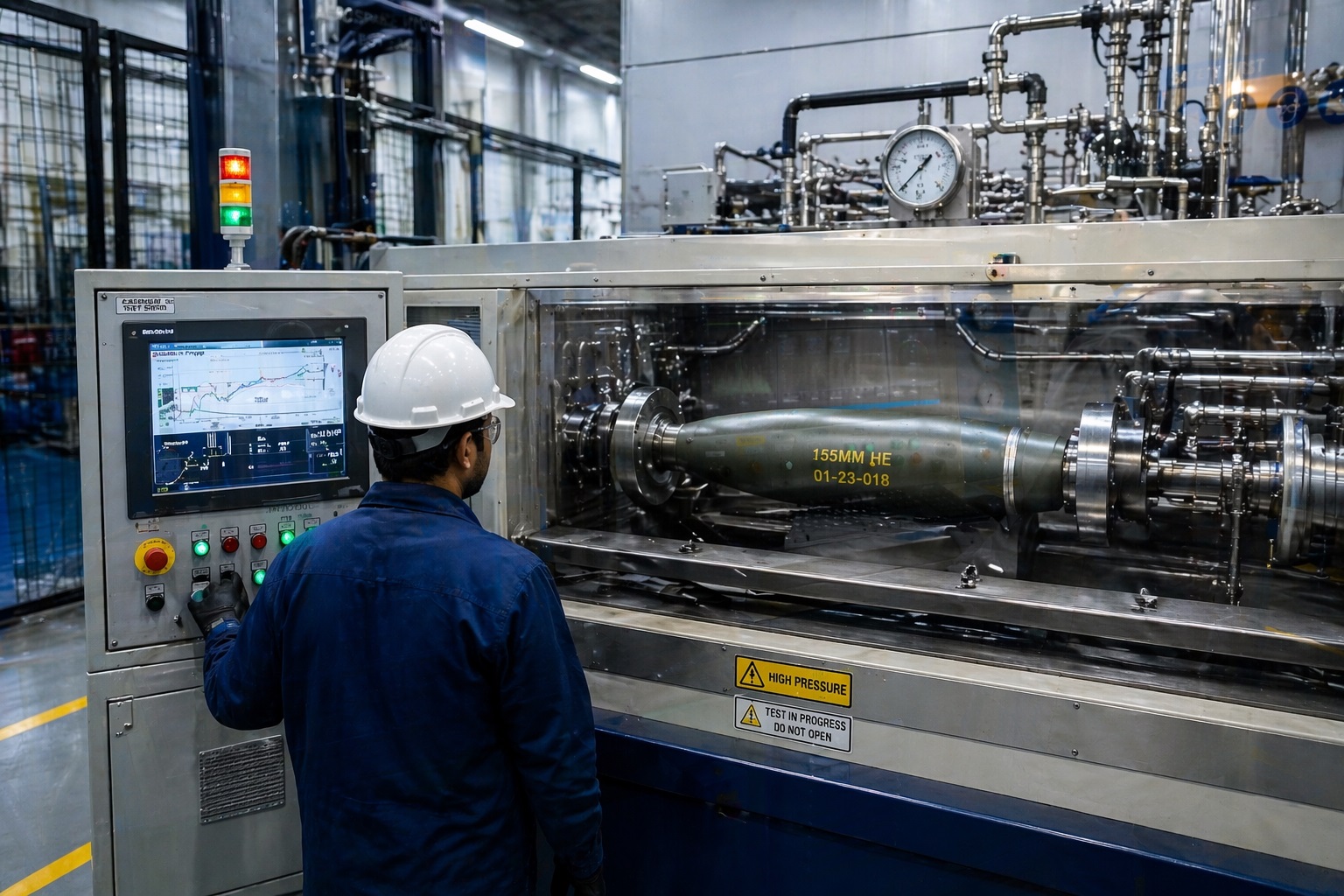
In modern defence manufacturing, ammunition quality control is no longer just a compliance requirement—it is a mission-critical process that directly impacts safety, performance, and operational readiness. For large-calibre ammunition such as 155mm artillery shells, even minor inconsistencies in pressure tolerance can lead to rejection, rework, or critical failure.
This case study explores how an Indian defence manufacturer significantly reduced rejection rates by implementing an advanced shell pressure testing machine, transforming both quality assurance and production efficiency.
1. The Challenge: High Rejection Rates in 155mm Shell QC
A leading Indian ammunition manufacturer (name withheld for confidentiality) was facing persistent challenges in its quality control process for 155mm artillery shells.
Despite having established inspection protocols, the manufacturer reported:
- High rejection rates during pressure validation testing
- Inconsistent results due to manual testing variations
- Limited traceability of test data
- Slower throughput affecting delivery timelines
The core issue lay in the existing testing methodology. Manual or semi-automated systems lacked the precision and repeatability required for high-pressure validation. Variations in pressure ramp-up, dwell time, and measurement accuracy resulted in false rejections and occasional undetected defects.
Additionally, the absence of automated data logging made it difficult to perform root cause analysis or demonstrate compliance during audits.
With increasing production demands and stricter defence quality standards, the manufacturer needed a scalable and reliable solution.
2. The Solution: Automated Hydraulic Pressure Testing
To address these challenges, the manufacturer implemented a fully automated shell pressure testing machine based on hydraulic testing principles.
The solution focused on three critical improvements:
1. Precision Pressure Control
The system enabled controlled pressure ramp-up and stabilization, ensuring accurate simulation of operational conditions.
2. Automated Test Cycles
Pre-programmed test sequences eliminated operator dependency, ensuring consistent and repeatable testing across batches.
3. Real-Time Data Acquisition
Integrated sensors and software captured pressure curves, leakage data, and performance metrics for every shell tested.
This shift from manual testing to automation significantly improved reliability while reducing variability in results.
3. The Results: Reduced Rejections & Increased Throughput
Within months of implementation, the manufacturer observed measurable improvements across key performance indicators.
- Rejection Rate Reduction: Reduced by [XX%]
- Testing Throughput: Increased by [XX%]
- Cycle Time per Unit: Reduced by [XX%]
- Data Traceability: 100% digital record for each test cycle
The reduction in false rejections was particularly significant. Previously, acceptable shells were sometimes rejected due to inconsistent testing conditions. With automated pressure control, test accuracy improved dramatically.
At the same time, the system ensured that defective shells were reliably identified, enhancing overall safety and compliance.
The improved throughput also enabled the manufacturer to meet increased defence production targets without compromising quality.
4. How the Neometrix BS-200 Machine Was Configured
The manufacturer deployed the Neometrix BS-200 Bomb Shell Testing Machine, customized specifically for 155mm ammunition testing requirements.
View Bomb Shell Testing Machine
Key Configuration Features:
- High-Pressure Hydraulic System: Designed to simulate real firing pressure conditions with precision control
- Custom Fixtures: Engineered to securely hold 155mm shells during testing
- PLC-Based Automation: Enables programmable test cycles and repeatability
- HMI Interface: User-friendly control panel for operators
- Digital Data Logging: Stores test results for traceability and audit compliance
- Safety Interlocks: Ensures safe operation under high-pressure conditions
The BS-200 system was further optimized with:
- Pressure ramp customization
- Leak detection thresholds aligned with defence standards
- Integration with factory QA systems
This level of customization ensured seamless integration into the existing production workflow.
5. Conclusion: Transforming Ammunition Quality Control
This case study demonstrates how automation is redefining ammunition quality control in India’s defence manufacturing sector.
By adopting an advanced shell pressure testing machine, the manufacturer achieved:
- Higher accuracy and repeatability
- Significant reduction in rejection rates
- Improved production efficiency
- Enhanced compliance and traceability
As defence production scales under initiatives like “Make in India,” the need for reliable and indigenous testing solutions will only grow.
6. Call to Action
If you are looking to improve ammunition testing accuracy and reduce rejection rates, Neometrix offers advanced hydraulic testing solutions tailored for defence applications.
Explore the BS-200 Bomb Shell Testing Machine and other defence-grade test systems.
Contact Neometrix for a Custom Solution
Note: This case study is based on real-world application scenarios. Final performance metrics should be validated with project-specific data.
Ammunition & Ordnance Testing for USA, UK & Europe: Neometrix ammunition testing systems are supplied to national armories and defence manufacturers in the United States, United Kingdom, and Europe. Our systems comply with MIL-STD-1916, STANAG 4003, and AQAP-2110 standards. All systems are DRDO-approved and available for export under government defence procurement frameworks.