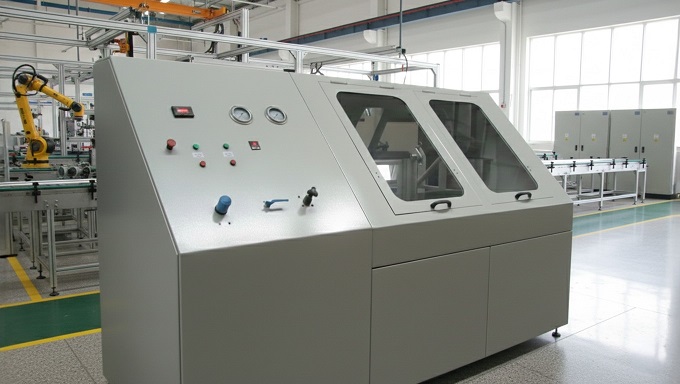

Every hydraulic hose assembly — from a 6mm bore brake line to a 50mm bore industrial hose — carries pressurised fluid under conditions that could result in personnel injury and equipment damage if it fails. Proof pressure testing, burst pressure testing, and leak testing are the quality assurance steps that verify each hose assembly meets its rated performance before it enters service. A hydraulic hose and tube proof test stand provides the controlled high-pressure environment for performing these tests safely, accurately, and with proper documentation.
A proof test stand pressurises hose and tube assemblies to controlled overpressure conditions using dual-source pressurisation, measures their response, and records test results — verifying that every assembly shipped meets its performance specification and can be traced to a test record.
Three Core Test Modes
Leak testing: Pressurising the hose to rated working pressure and monitoring for pressure decay, fluid seepage at fittings, or moisture formation on the hose surface. Verifies that the assembly maintains integrity at service conditions.
Proof pressure testing: Pressurising to 2× rated working pressure (the standard proof ratio per SAE J517) for a specified hold time. Any fitting slip, hose bulge, visible leakage, or pressure decay constitutes a failure. The most common production acceptance test for hydraulic hose assemblies.
Burst pressure testing: Pressurising to failure to determine the actual burst pressure. SAE J517 requires burst pressure to be at least 4× rated working pressure for high-pressure hydraulic hose. Burst testing is a design qualification and batch sampling test, not performed on every assembly.
Elongation testing: Measuring the change in hose length under pressure (elongation or shortening depending on braid angle). Relevant for applications where hose length change under pressure affects system geometry or creates stress on fittings.
Dual-Source Pressurisation Architecture
Electric Rexroth gear pump: Provides high-flow low-pressure prefill capability — quickly filling the hose volume and raising pressure to an intermediate level before the Haskel takes over. This avoids using the air-driven Haskel for the entire pressurisation range, which would be slow and inefficient for the low-pressure filling phase.
Air-driven Haskel high-pressure pump: Takes over from the Rexroth pump at intermediate pressure and drives the system to full test pressure — up to 690 bar (10,000 psi). The Haskel’s air-driven design provides precise, controllable pressure ramp without electrical power in the high-pressure circuit.
This dual-source architecture combines the flow efficiency of the electric pump with the high-pressure capability of the Haskel, minimising total test cycle time.
Key Specifications
| Parameter | Specification |
|---|---|
| Maximum test pressure | 690 bar (10,000 psi) |
| Pressurisation | Dual-source: Rexroth gear pump + Haskel air-driven |
| Test modes | Leak, elongation, burst |
| Safety enclosure | Interlocked hood with polycarbonate windows |
| Timer | Programmable hold timer |
| Safety features | Pressure relief valves, emergency stop, interlocked access |
Safety Architecture
High-pressure hose burst testing is energetically significant. A hose at 690 bar stores substantial elastic energy and pressurised fluid. Burst failure can project fittings at high velocity and release hot or flammable fluid. The test stand’s safety architecture addresses this:
Interlocked safety hood: The test chamber is enclosed in a safety hood with polycarbonate observation windows. The hood must be fully closed and latched before pressurisation is possible — an interlock prevents the pressurisation sequence from starting with the hood open.
Pressure relief valve: Automatic venting if pressure exceeds the set maximum — prevents inadvertent over-pressurisation beyond the test stand’s rated capacity.
Emergency stop: Immediately closes all supply valves and opens vent paths — rapidly depressurising the test circuit without requiring access to the pressurised zone.
Laser elongation measurement: Non-contact measurement of hose elongation during pressurisation, without requiring any device in proximity to the pressurised assembly.
International Standards
| Standard | Scope |
|---|---|
| SAE J517 | Hydraulic hose — performance requirements including proof and burst ratios |
| SAE J1273 | Hydraulic hose assemblies — selection and use |
| EN 853/854/856 | Hydraulic rubber hose — European standards |
| ISO 1436 | Rubber hoses and assemblies — wire reinforced |
| ASTM D380 | Test methods for rubber hose |
Applications
Industrial hydraulic hose production: End-of-line proof pressure testing for every hose assembly produced — the standard quality gate in hydraulic hose manufacturing plants.
Aerospace and defence: Proof testing of hydraulic, fuel, and pneumatic hose assemblies before installation in aircraft, vehicles, and ground support equipment — required by maintenance manuals and quality assurance programmes.
MRO facilities: Testing repaired or re-crimped hose assemblies before returning them to service. Any hose assembly where the fitting crimp has been disturbed must be proof-tested before use.
Construction and industrial equipment: Hoses for high-force hydraulic machinery — excavators, presses, mining equipment — proof-tested as part of the original equipment manufacturer’s quality process.
Neometrix Hydraulic Hose/Tube Proof Test Stand
A heavy-duty, floor-mounted proof test stand for hose and tube assemblies to 690 bar (10,000 psi). Dual-source pressurisation (Rexroth gear pump + Haskel air-driven), interlocked safety hood with polycarbonate windows, laser elongation measurement, programmable hold timer, pressure relief, and emergency stop.
→ View Full Specifications
→ Request a Quote
FAQ
Q: What is the standard proof pressure ratio for hydraulic hose assemblies?
A: SAE J517 specifies that proof pressure must be at least 2× the rated maximum working pressure (MAWP) of the hose. This means a hose rated at 350 bar MAWP must survive proof testing at 700 bar without visible leakage, fitting slip, or structural damage. SAE J517 also specifies that minimum burst pressure must be at least 4× MAWP. These ratios are the standard for hydraulic hose in the USA and internationally referenced. European standards (EN 853/854/856) have equivalent requirements. The Neometrix test stand’s 690 bar maximum covers proof testing for hoses rated up to 345 bar MAWP, and burst testing for hoses rated up to 172 bar.
Q: Why use dual-source pressurisation rather than a single pump?
A: A Haskel air-driven intensifier is ideal for high-pressure work but has limited flow capacity — filling a large hose volume from atmospheric to working pressure with a Haskel alone would be very slow. An electric gear pump fills the hose volume quickly and efficiently up to intermediate pressure. The Haskel then takes over only for the high-pressure phase, where flow demand is low and precision pressure control is needed. Dual-source architecture minimises total test cycle time while providing the pressure range needed for burst testing — important for production environments where test throughput directly affects capacity.
Q: When must a hydraulic hose assembly be proof-tested?
A: Proof testing is required: for every new hose assembly produced by a hose manufacturer supplying to SAE J517 or equivalent standards; for any assembly where the end fitting has been re-crimped or re-swaged after original manufacture; for assemblies that have been stored beyond their shelf life limit; for assemblies returning from MRO where any fitting or hose section has been disturbed; and for any assembly where visual inspection reveals evidence of damage, abrasion, or fitting movement. Any time the integrity of a hose assembly’s fitting-to-hose connection cannot be confirmed by other means, proof testing provides the definitive verification.
Neometrix Defence Ltd. manufactures hydraulic hose and tube proof test stands for aerospace, defence, and industrial hose testing. [email protected] | +91-7777-876-876