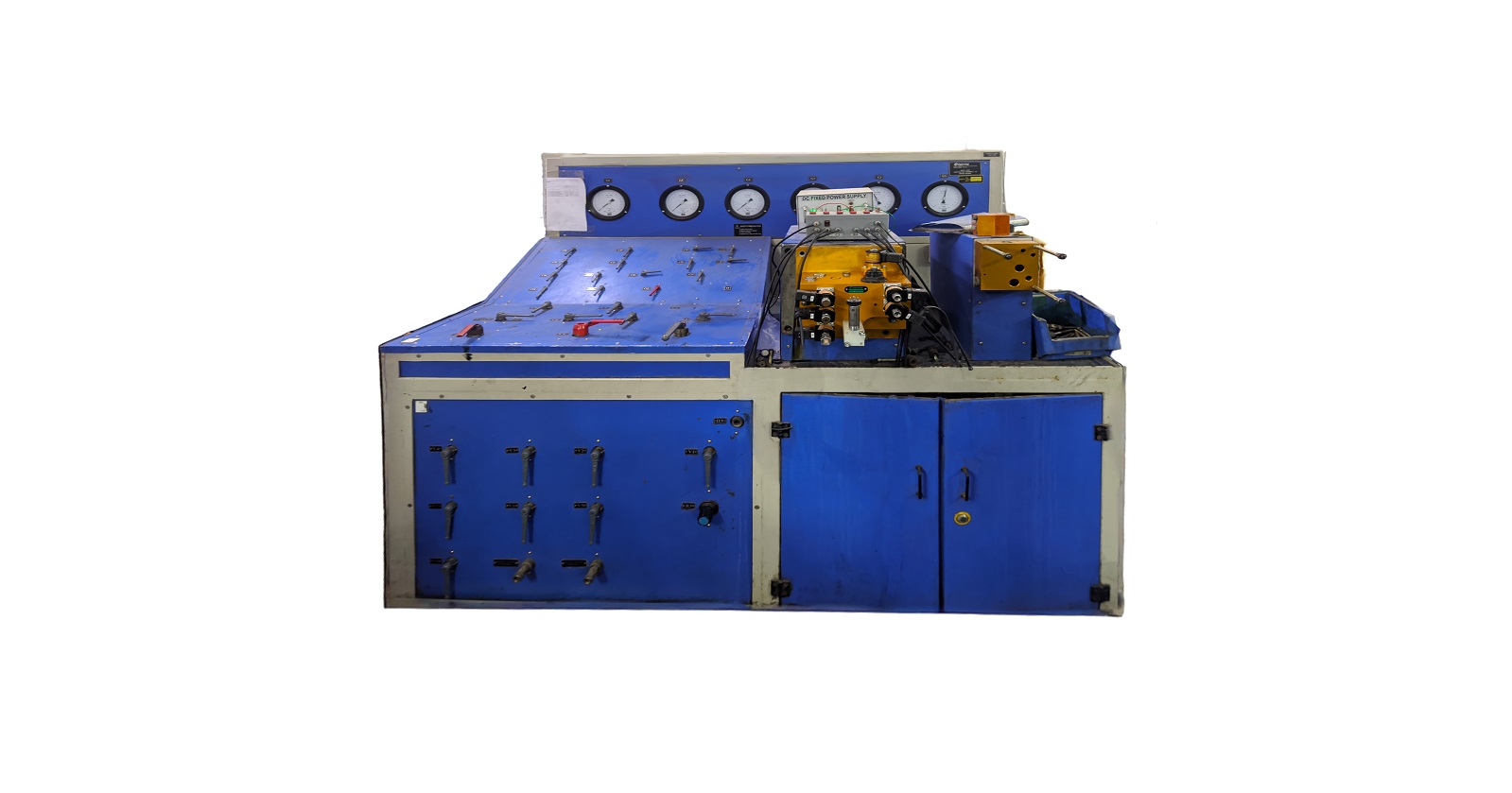

Railway locomotives depend on multiple redundant braking systems to stop safely under all operational conditions — loaded and unloaded, in all weather, at all speeds. The E-70 braking system is used on a range of locomotive types where hydraulic and pneumatic brake components work together to apply, control, and release braking force. Every E-70 brake component that enters service after manufacture, overhaul, or repair must be comprehensively tested under both hydraulic and pneumatic conditions to verify its functional performance before it is trusted to stop a locomotive.
The E-70 Brake Equipment Test Rig is a fully automated, turnkey solution that subjects E-70 brake valves, cylinders, and associated components to the complete range of functional, leakage, endurance, and dynamic response tests required by COFMOW (Committee on Standardisation and Research in Railway Workshops) and Indian Railways specifications.
What E-70 Brake Components Are Tested
The E-70 braking system includes a range of hydraulic and pneumatic components: distributor valves, brake cylinders, control valves, safety valves, slack adjusters, and pressure switches. Each component type has its own test protocol defining the pressures, functions, and acceptance criteria that must be demonstrated during testing.
Four Core Test Types
Functional testing: Verifying that each valve or component performs its intended function correctly — opening at the correct pressure, switching at the correct signal, providing the correct output pressure or flow response. Functional testing maps the complete operating characteristic of the component.
Leakage testing: Verifying that internal and external leakage does not exceed the specified limits at rated pressure. For brake components, both internal leakage (affecting brake modulation accuracy) and external leakage (safety and fluid loss) are tested.
Endurance testing: Cycling the component through its operating cycle for a defined number of cycles at rated conditions — verifying durability and identifying wear-related performance changes before they occur in service on a locomotive.
Dynamic response testing: Measuring how quickly a valve or component responds to command signals — particularly critical for brake application and release response times that directly affect stopping distance and ride quality.
Key Technical Capabilities
Dual-domain testing: The rig integrates both hydraulic (up to 1,060 kg/cm² — approximately 1,040 bar) and pneumatic (up to 10 kg/cm², approximately 9.8 bar, with ≤5°C dew-point dry air) circuits in a single platform, covering both the hydraulic and pneumatic aspects of the E-70 brake system without requiring multiple dedicated test rigs.
22 analog plus 2 digital pressure gauges: NIST/NABL traceable calibration across all instrumentation channels provides the measurement accuracy and documentation quality required for railway procurement and maintenance quality assurance.
PLC-driven automation with touchscreen HMI: Automated test sequences reduce operator-to-operator variation and ensure each test is executed exactly to the defined protocol, with real-time monitoring and automatic data logging.
Fail-safe safety systems: Auto-locking clamps that engage during power failure, mushroom-head emergency stops at multiple locations, interlocked electrical/hydraulic/pneumatic circuits, and IEC 60204-1 compliant design — essential for a test rig operating at over 1,000 bar hydraulic pressure.
Multi-language PLC interface: Supporting operational use across diverse workshop environments with different language requirements.
Long-term reliability design: Stress-relieved cast iron structure, centralised lubrication, 15-year spare parts availability commitment — reflecting the maintenance workshop environment where this equipment operates continuously for decades.
COFMOW/IR Standards Compliance
COFMOW (Committee on Standardisation and Research in Railway Workshops) produces the technical standards and specifications for railway workshop equipment and procedures in India. The E-70 Brake Equipment Test Rig is designed and certified to meet COFMOW/IR standards for locomotive brake component testing, providing the documented performance verification required for Indian Railways maintenance quality assurance.
Applications
Railway workshop maintenance depots: Comprehensive testing of E-70 brake components removed from locomotives during scheduled maintenance, verifying performance before return to service.
Locomotive manufacturing: Acceptance testing of E-70 brake components during new locomotive production, verifying each component meets specification before locomotive assembly.
R&D and new product development: Performance benchmarking of new brake valve designs against existing components and against specification.
Training: Providing technicians with hands-on testing experience in a controlled workshop environment.
Neometrix E-70 Brake Equipment Test Rig
Fully automated turnkey test rig for locomotive E-70 brake components. Hydraulic circuit to 1,060 kg/cm², pneumatic circuit to 10 kg/cm² (≤5°C dew-point), 22+2 pressure gauges (NIST/NABL traceable), PLC/DAQ with HMI, functional/leakage/endurance/dynamic response test capability. Fail-safe safety systems per IEC 60204-1. COFMOW/IR certified. 2-year warranty, 15-year spare parts availability.
→ View Full Specifications
→ Request a Quote
FAQ
Q: What is the E-70 braking system and where is it used?
A: The E-70 is a combined hydraulic and pneumatic braking system used on locomotive types in the Indian Railways fleet and certain export locomotive designs. It uses hydraulic pressure for brake application force generation and pneumatic control for system activation and modulation. The system includes multiple valve and actuator components — distributors, control valves, brake cylinders, safety valves — each requiring separate testing to verify their individual function and performance before the assembled system can be trusted in service.
Q: Why does a brake equipment test rig need both hydraulic and pneumatic circuits?
A: The E-70 brake system uses both hydraulic and pneumatic subsystems that must be tested at their respective operating media and pressures. Hydraulic components in the brake actuation circuit operate at high pressure (up to 1,060 kg/cm²) with hydraulic fluid. Pneumatic components in the control circuit operate at compressed air pressures (up to 10 kg/cm²) with dry air to specified dew-point. A test rig serving the full E-70 brake system must include both circuits to avoid the inefficiency and traceability complications of using separate rigs for different component types from the same brake system.
Q: What is NIST/NABL traceable calibration and why is it required for railway workshop testing?
A: NIST (USA National Institute of Standards and Technology) and NABL (National Accreditation Board for Testing and Calibration Laboratories, India) are national calibration accreditation bodies. Traceable calibration means the measurement equipment used in testing has been calibrated against standards that are themselves traceable through an unbroken chain to the relevant national standard. For railway maintenance documentation, traceable calibration is required to demonstrate that the test results are based on measurements with known, documented accuracy — not just nominally calibrated instruments. This supports the audit trail for quality assurance and safety certification of maintained components.
Neometrix Defence Ltd. designs and manufactures E-70 brake equipment test rigs for railway locomotive maintenance workshops. [email protected] | +91-7777-876-876