Modern electronics — whether powering a fighter jet’s avionics, a satellite’s communication module, or an industrial control system — must be verified to perform flawlessly under every operating condition before they ever reach deployment. Manual testing of complex circuit boards and electronic assemblies is slow, inconsistent, and simply not scalable for today’s production volumes.
Modern Universal Automatic Test Equipment (MUATE) is the solution that aerospace, defence, and industrial electronics manufacturers worldwide depend on to verify electronic assemblies quickly, accurately, and with complete traceability.
What is Automated Test Equipment (ATE)?
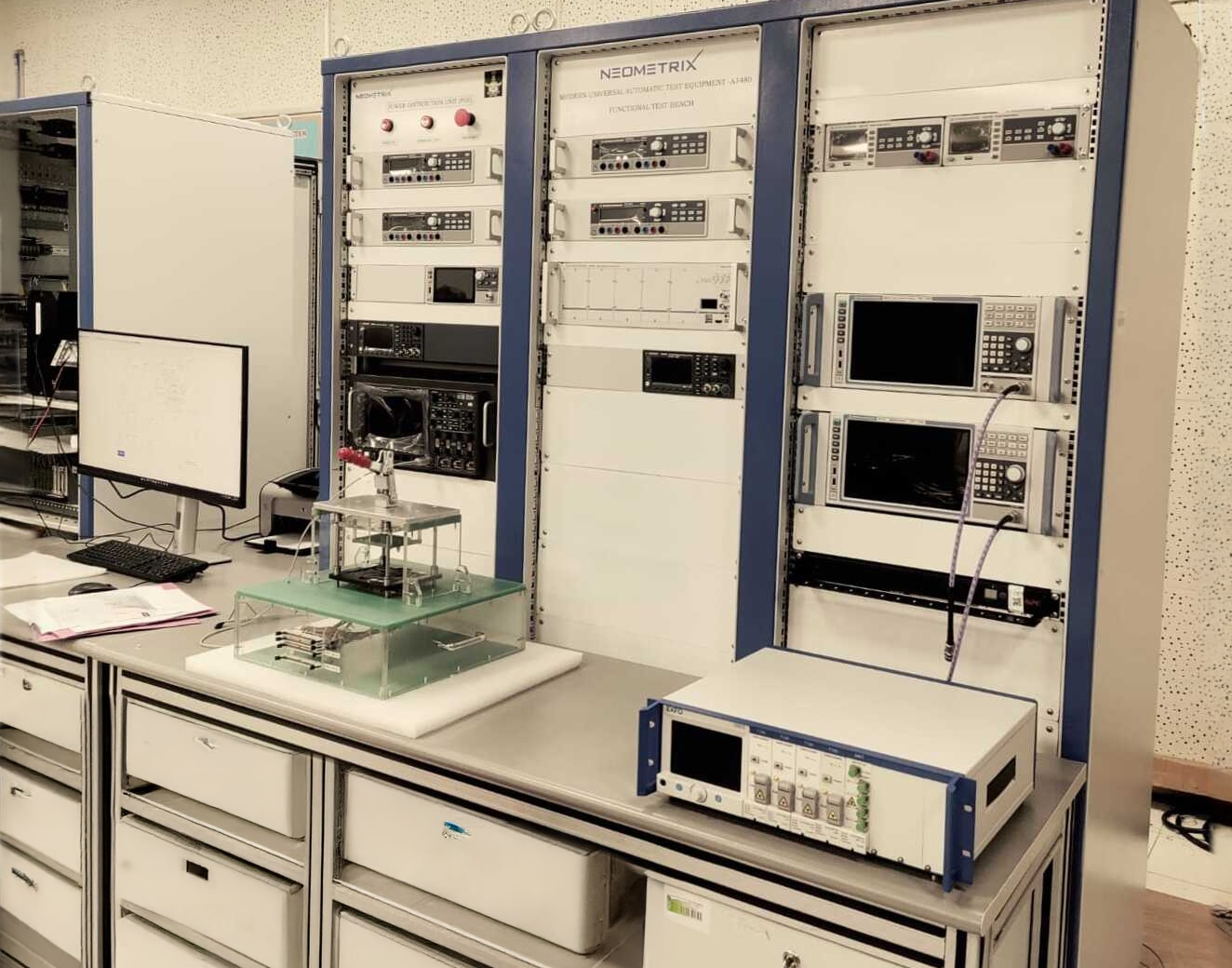
Automated Test Equipment (ATE) is a computer-controlled system that tests electronic devices — printed circuit boards (PCBs), integrated circuits (ICs), modules, and complete assemblies — automatically, without human intervention at the measurement level.
An ATE system applies signals to the device under test (DUT), measures its responses, compares them against expected values, and generates a pass/fail result with full diagnostic data — all within seconds to minutes per board.
Modern ATE systems replace dozens of separate bench instruments (oscilloscopes, signal generators, multimeters, RF analysers) with a single integrated platform controlled by software — typically National Instruments LabVIEW for high-complexity defence and aerospace applications.
Core Testing Methods in Modern Universal ATE
In-Circuit Testing (ICT)
ICT uses a bed-of-nails fixture to make electrical contact with specific test points on the PCB. It verifies:
- Component presence and correct placement
- Resistor, capacitor, and inductor values
- Solder joint continuity
- Short circuits between nets
ICT catches manufacturing defects before functional testing, dramatically reducing rework costs.
Boundary Scan / JTAG Testing
JTAG (Joint Test Action Group) testing, standardised as IEEE 1149.1, uses a serial scan chain built into ICs to test interconnections between devices without physical probes.
This is critical for modern high-density PCBs where physical test access is limited. JTAG testing verifies:
- IC-to-IC interconnects
- Memory interfaces (DDR, Flash)
- FPGA and microprocessor connections
- Board-level continuity
Functional Testing
After ICT and boundary scan verify manufacturing quality, functional testing verifies that the PCB performs its intended function — simulating real operating conditions and measuring outputs against specifications.
RF and Signal Analysis
For RF modules, radar systems, and communication electronics, ATE platforms incorporate spectrum analysis, signal generation, and modulation analysis — testing antenna interfaces, transmitter power, receiver sensitivity, and frequency accuracy.
Why LabVIEW for Aerospace and Defence ATE?
National Instruments LabVIEW is the dominant platform for complex ATE development in aerospace and defence for three reasons:
1. Instrument integration — LabVIEW natively supports hundreds of instruments via GPIB, PXI, VXI, and USB, allowing a single software environment to control an entire test station.
2. Parallel testing — LabVIEW’s graphical dataflow architecture enables multiple tests to run simultaneously, significantly reducing test cycle time.
3. MIL-STD compliance — LabVIEW-based systems can be documented and validated to meet MIL-STD-810, MIL-STD-461, and ARINC 429 requirements — mandatory for defence procurement in the USA, UK, and NATO nations.
4. Traceability — Every test result is logged with timestamps, serial numbers, and operator IDs — essential for AS9100 and DO-178C compliance in aerospace supply chains.
International Standards Governing ATE in Aerospace and Defence
| Standard | Region | Scope |
|---|---|---|
| MIL-STD-810 | USA / NATO | Environmental testing of military equipment |
| MIL-STD-461 | USA / NATO | Electromagnetic compatibility (EMC) testing |
| ARINC 429 | International | Avionics data bus standard |
| IEEE 1149.1 (JTAG) | International | Boundary scan testing standard |
| IEC 61508 | Europe / Global | Functional safety for electronic systems |
| DO-178C | International | Software considerations for airborne systems |
| AS9100 | International | Quality management for aerospace |
Industries and Applications for Universal ATE
Aerospace and Avionics
Avionics PCBs — flight computers, navigation systems, engine control units, radar processors — must meet the most stringent reliability requirements of any electronics application. Universal ATE verifies every board before installation, with full traceability documentation for aviation authority approval.
Defence Electronics
Military electronics face extreme environments: shock, vibration, temperature extremes, and electromagnetic interference. ATE systems verify that defence electronics meet MIL-STD requirements before deployment. Applications include radar systems, communication equipment, weapons guidance electronics, and vehicle control systems.
Space and Satellite
Electronics destined for space cannot be serviced after launch. Every component must be tested exhaustively on the ground. ATE platforms with environmental simulation capability (thermal cycling, vacuum) are standard in satellite manufacturing.
Industrial Automation
Industrial control boards, PLCs, and power electronics require functional verification before installation in production lines. ATE reduces the cost of field failures dramatically.
Manual Testing vs Universal ATE — Why Automation Wins
| Factor | Manual Bench Testing | Universal ATE |
|---|---|---|
| Test cycle time | 30–120 min per board | 2–10 min per board |
| Operator dependency | High | Minimal |
| Repeatability | Variable | Consistent every cycle |
| Fault coverage | 40–60% typical | 85–95%+ with JTAG+ICT |
| Documentation | Manual logs | Automated digital records |
| Scalability | Low | High — same platform, new software |
Neometrix Modern Universal Automatic Test Equipment (MUATE)
The Neometrix MUATE is a LabVIEW-based universal automatic test system designed for comprehensive electronics testing across defence, aerospace, and industrial applications.
Capabilities:
- PCB and IC testing via ICT, JTAG/boundary scan, and functional test methods
- RF and signal analysis for communication and radar electronics
- MIL-STD-810 and MIL-STD-461 compliant test documentation
- ARINC 429 avionics bus testing support
- Modular architecture — configurable for specific DUT requirements
- Full automated test report generation with traceability
→ View Full MUATE Specifications
→ Request a Quote
Frequently Asked Questions
Q: What is Automated Test Equipment (ATE)?
A: Automated Test Equipment is a computer-controlled system that tests electronic devices automatically. It applies signals to the device under test, measures responses, and generates pass/fail results with diagnostic data — replacing manual bench testing with faster, more consistent, and fully documented automated measurement.
Q: What is LabVIEW and why is it used in aerospace ATE?
A: LabVIEW is a graphical programming environment by National Instruments, widely used for ATE development in aerospace and defence. It supports integration of hundreds of instruments, enables parallel testing, and produces documentation compatible with MIL-STD and AS9100 compliance requirements.
Q: What is JTAG testing?
A: JTAG (IEEE 1149.1) is a boundary scan testing method that uses a serial scan chain built into ICs to test board-level interconnections without physical probes. It is essential for high-density PCBs where bed-of-nails access is not possible, and is standard in aerospace and defence electronics testing.
Q: What standards apply to ATE for defence electronics in the USA and UK?
A: The primary standards are MIL-STD-810 (environmental testing), MIL-STD-461 (EMC), and MIL-STD-1553 (data bus). UK defence procurement additionally references DEF STAN 00-35 for environmental testing. Both the US DoD and UK MoD require full test traceability documentation from ATE systems.
Q: What is the difference between ICT and functional testing in PCB testing?
A: ICT (In-Circuit Testing) verifies manufacturing quality — component values, placement, and solder joints. Functional testing verifies that the PCB performs its intended function under simulated operating conditions. Both are typically required for aerospace and defence electronics qualification.
Q: Which industries use Universal ATE systems?
A: Primary industries include aerospace and avionics, defence electronics, space and satellite manufacturing, telecommunications, industrial automation, and automotive electronics. Any industry requiring high-reliability electronics with documented test traceability uses ATE systems.
Q: What is the fault coverage of modern ATE systems?
A: Modern ATE combining ICT, JTAG boundary scan, and functional testing typically achieves 85–95% fault coverage. This compares to 40–60% achievable with manual bench testing, making ATE the standard for any production environment where reliability and documentation matter.
Neometrix Defence Ltd. designs and manufactures custom ATE systems for aerospace, defence, and industrial electronics testing. Systems are built on LabVIEW platforms with MIL-STD compliance documentation. Contact: [email protected] | +91-7777-876-876