Every helmet sold for motorcycle riding, industrial work, military operations, or sports must pass rigorous impact absorption testing before it is legally placed on the market. The test method is straightforward in principle: drop the helmet from a defined height onto a standardised anvil and measure the peak acceleration transmitted to the headform inside.
A head impact test rig is the precision instrument that performs this test — and the quality of the rig, the calibration of its instrumentation, and its compliance with applicable standards determine whether the test result is legally valid or worthless.
How Head Impact Testing Works
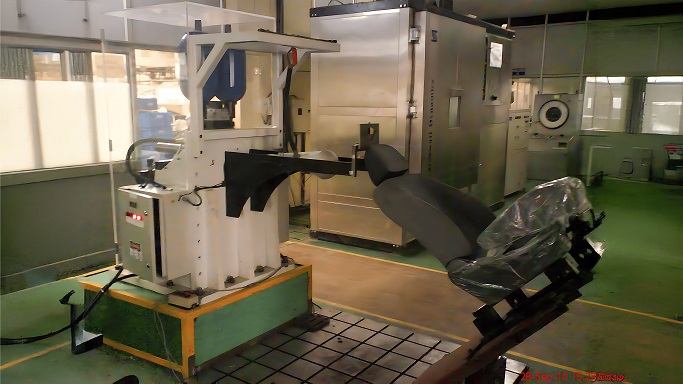
The fundamental test method across all major standards uses a guided drop or pendulum impact:
1. Instrumented headform: A standardised headform (shaped like a human head, in defined sizes) carries a triaxial accelerometer at its centre of gravity. The headform is mounted on a guided drop assembly or pendulum arm.
2. Defined impact velocity: The test standard specifies the impact velocity (derived from drop height). Common impact velocities range from 5.5 m/s (industrial) to 7.5 m/s (motorcycle) depending on the standard.
3. Anvil types: Standards specify different anvil shapes to simulate different impact surfaces: flat (general impact), hemispherical (concentrated force), kerbstone (angular impact), and oblique angled surfaces.
4. Peak acceleration measurement: The accelerometer measures the deceleration of the headform on impact. Pass/fail criterion is peak acceleration — typically expressed as a maximum g-value (e.g., 275g per ECE 22.06 for motorcycle helmets).
5. HIC calculation: The Head Injury Criterion (HIC) is a time-integrated acceleration measure that correlates with brain injury risk. Many standards specify both peak g and maximum HIC value.
International Testing Standards
| Standard | Region | Application |
|---|---|---|
| ECE 22.06 | Europe / International | Motorcycle helmet — UN regulation |
| EN 397 | Europe | Industrial safety helmets |
| EN 1078 | Europe | Bicycle and skateboard helmets |
| EN 443 | Europe | Firefighter helmets |
| ANSI Z89.1 | USA | Industrial hard hats |
| DOT FMVSS 218 | USA | Motorcycle helmets (Federal Motor Vehicle Safety Standard) |
| SNELL M2020 | USA / International | Motorcycle helmet (voluntary, highest standard) |
| AS/NZS 1698 | Australia/NZ | Motorcycle helmets |
| MIL-DTL-44099 | USA | Military combat helmets (ACH, ECH) |
| STANAG 2920 | NATO | Ballistic protective equipment |
Defence and Military Helmet Testing
Military combat helmets (Advanced Combat Helmet/ACH, Enhanced Combat Helmet/ECH) require testing per MIL-DTL-44099 and related specifications. In addition to ballistic protection (tested separately), combat helmets must meet blunt impact performance requirements — tested on precisely calibrated head impact test rigs with military-specified headforms.
NATO member nations procuring helmets reference STANAG 2920 for ballistic requirements and national military specifications for blunt impact performance. UK MoD, US DoD, and European defence procurement all require test documentation from accredited test laboratories with calibrated, traceable test equipment.
Industrial Safety Helmet Testing
EN 397 (Europe) and ANSI Z89.1 (USA) govern industrial hard hats. Testing includes shock absorption (impact test), penetration resistance, and retention system performance. Test facilities serving PPE manufacturers across the EU, UK, USA, and Middle East must operate head impact test rigs traceable to these standards.
In the Middle East, Gulf Cooperation Council (GCC) countries increasingly align with EN standards for PPE certification. Saudi SASO and UAE ESMA both reference EN 397 for industrial safety helmets used in construction, oil and gas, and manufacturing.
Automotive and Motorcycle Helmet Testing
ECE 22.06 came into force in 2023 as the revised UN motorcycle helmet regulation, with significantly more stringent oblique impact requirements than its predecessor. All motorcycle helmets sold in ECE signatory countries (54 nations, including all EU member states, the UK, and many Middle Eastern nations) must be tested to ECE 22.06 by approved technical services.
DOT FMVSS 218 is the US federal mandatory standard. SNELL M2020 is the voluntary high-performance standard used for racing helmets.
Neometrix Head Impact Test Rig
The Neometrix Head Impact Test Rig is a precision guided-drop impact test system for helmet and protective headgear testing. Configurable for ECE 22.06, EN 397, ANSI Z89.1, DOT FMVSS 218, and military specifications.
Features include instrumented headforms in standard sizes, multiple anvil types, high-speed data acquisition for peak-g and HIC calculation, and automated test reporting.
→ View Specifications
→ Request a Quote
FAQ
Q: What is the Head Injury Criterion (HIC)?
A: HIC is a measure of the severity of an impact to the head, calculated from the time history of head acceleration. It correlates with the probability of brain injury. Most helmet standards specify a maximum HIC value alongside a peak acceleration limit. For example, ECE 22.06 specifies HIC ≤ 2400 for motorcycle helmets.
Q: What is ECE 22.06 and how does it differ from the previous standard?
A: ECE 22.06 is the latest revision of the UN motorcycle helmet regulation, mandatory in all ECE signatory countries since 2023. Key additions over ECE 22.05 include: rotational motion test (assessing oblique impact performance), extended test locations on the helmet, and stricter peak acceleration limits. Any new motorcycle helmet type approval must now meet ECE 22.06.
Q: What standard applies to motorcycle helmets in the USA?
A: DOT FMVSS 218 is the mandatory US federal standard. SNELL M2020 is a more stringent voluntary standard used for racing and high-performance helmets. California requires both DOT and SNELL for track use. Some manufacturers certify to both DOT and ECE 22.06 for global market access.
Q: What standards apply to industrial safety helmets in the Middle East?
A: GCC countries increasingly reference EN 397 (European standard for industrial safety helmets) for PPE certification. Saudi SASO and UAE ESMA both recognise EN 397 compliance for industrial hard hats. Construction and oil and gas sectors in the Gulf region require EN 397 certified helmets on most major project sites.
Q: How is military helmet impact testing different from civilian standards?
A: Military helmet impact testing follows defence-specific specifications (MIL-DTL-44099 for US combat helmets) which include blunt impact testing, retention system testing, and environmental conditioning (temperature, humidity, UV exposure) before testing. NATO STANAG 2920 covers ballistic testing. Military test rigs must produce documentation meeting defence quality assurance standards (AQAP-2110 in NATO countries).
Neometrix Defence Ltd. manufactures head impact test rigs for defence, industrial, and automotive helmet testing. [email protected]