
The relationship between a helicopter and corrosion is adversarial and ongoing. Salt-laden air from maritime operations, dust and sand from desert and brownout environments, exhaust residues from the powerplant, and industrial atmospheric contamination all deposit on airframe surfaces and penetrate into joints, hinges, rotor head components, and dynamic system interfaces. Left unaddressed, this contamination initiates corrosion that progresses from surface pitting to intergranular attack in aluminium structures, and eventually causes fatigue crack initiation in highly-stressed components.
Helicopter manufacturers address this in their maintenance documentation — specifically in the Corrosion Prevention and Control Programme (CPCP) — by specifying scheduled wash intervals, approved cleaning agents, and permitted water pressures for washing different zones of the aircraft. A helicopter washing rig that delivers the correct water pressure and flow, at the correct temperature, using approved detergents, is the ground support equipment that makes this maintenance programme executable.
What Scheduled Washing Actually Does
The primary objective of scheduled washing is contamination removal before it causes corrosion initiation. Salt deposits are hygroscopic — they attract moisture from the atmosphere and maintain a wet layer at the metal surface even in dry conditions. This wet layer is the electrolyte that drives electrochemical corrosion. Removing the salt deposit removes the electrolyte source, stopping the corrosion before it starts rather than treating it afterwards.
Secondary objectives include: removal of hydraulic and oil deposits that mask surface condition and attract further contamination; maintaining lubrication access to inspection panels and hinges (contamination causes these to bind or corrode shut); and enabling visual inspection of surfaces that would be obscured by accumulated contamination.
Water Pressure Requirements and Zone Restrictions
Helicopter manufacturers specify different maximum water pressures for different zones of the aircraft. Composite rotor blades, sealed electronics bays, and certain avionics enclosures have lower maximum pressure limits than metal airframe skin panels. Exceeding the permitted pressure can drive water into sealed joints, damage erosion protection coatings, or delaminate composites.
A helicopter washing rig with adjustable pressure — typically 40–200 psi (approximately 2.8–14 bar) — and a means of verifying delivered pressure allows maintainers to work to the correct pressure for each zone rather than using a fixed-pressure supply. Temperature control (warm water washing is more effective for removing grease and hydraulic fluid contamination than cold water alone) improves cleaning effectiveness without requiring higher pressure.
Wash Intervals and Operational Environment
The OEM maintenance manual specifies wash intervals as a function of operating environment:
- Maritime (shipborne, offshore, coastal): Most demanding — daily or every-flight flushing of exposed salt may be required, with full washes every 7–14 days.
- Desert/arid: Sand and dust accumulation; full wash typically every 14–28 days, more frequently if chemical or industrial atmospheric contamination is present.
- Temperate/standard: Monthly or longer intervals may be acceptable, depending on the specific aircraft type and operator’s approved maintenance programme.
Military helicopter programmes — particularly US Army (Apache, Black Hawk, Chinook), UK Army Air Corps, and Gulf armed forces helicopter fleets — operate in particularly demanding environments that require aggressive wash programmes. The US Army’s AMCOM (Aviation and Missile Command) and the UK’s DAECOM (Defence Aviation Engineering and Certification Organisation) both publish guidance on corrosion prevention and washing requirements for their respective fleets.
Approved Cleaning Agents
Not all detergents are suitable for helicopter washing. Chlorinated cleaners can damage aluminium alloys. Highly alkaline cleaners attack anodised and conversion-coated surfaces. Solvents may be incompatible with certain paint and primer systems. The helicopter OEM specifies the approved cleaning compounds in the Component Maintenance Manual (CMM) or the aircraft maintenance manual (AMM), and departing from this list requires approval.
MIL-PRF-87937 (USA) is the military specification for aircraft washing compounds — it defines multiple types for different contamination levels and surface types, and is widely referenced by both military and commercial operators as a baseline for agent selection.
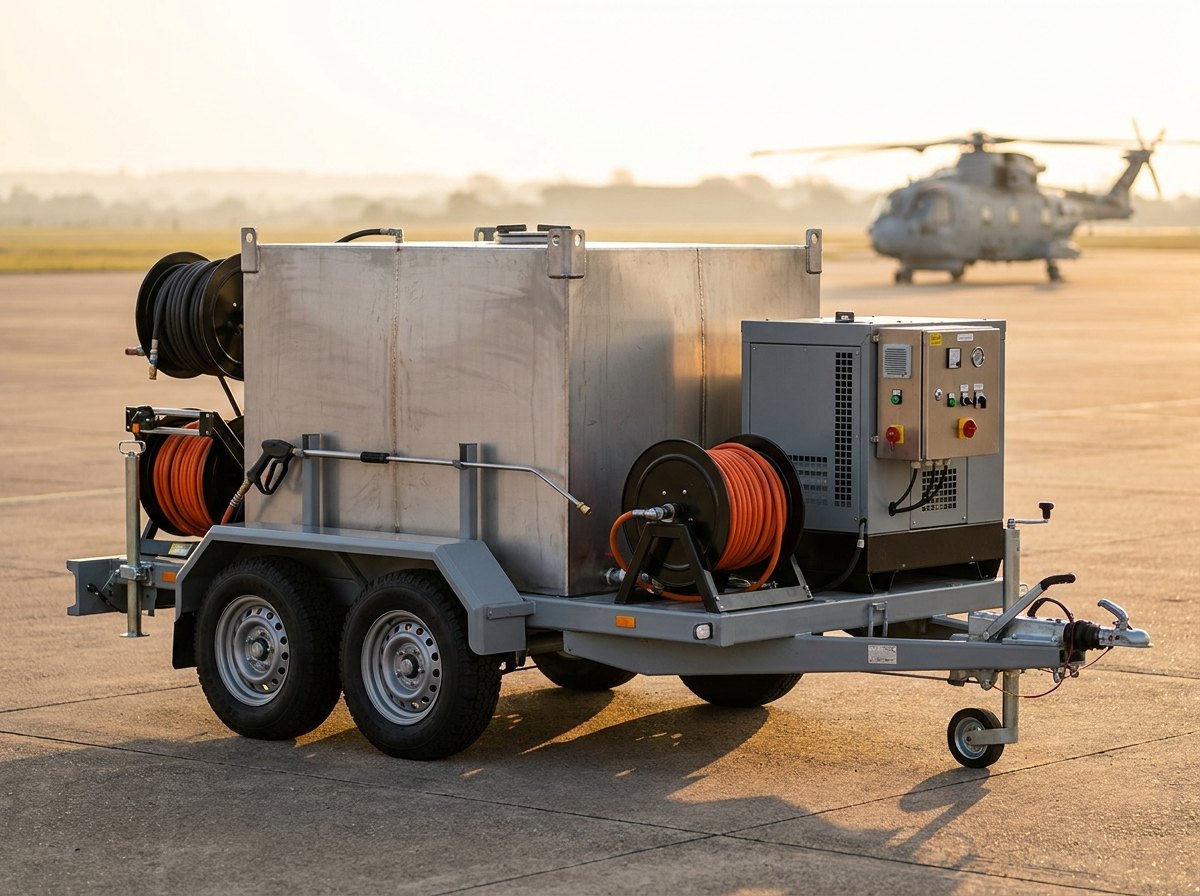
Neometrix Helicopter Washing Rig
A purpose-built helicopter washing system with adjustable water pressure (40–200 psi), temperature control, approved detergent injection, and the configuration needed to deliver a compliant wash programme as defined in the aircraft OEM’s maintenance documentation. Suitable for military and commercial helicopter types.
→ View Full Specifications
→ Request a Quote
FAQ
Q: How often should a military helicopter be washed in a maritime environment?
A: The answer is aircraft-specific and is found in the type’s maintenance manual, but for most military helicopter types operating in maritime environments — shipborne, near-shore, or offshore — the Corrosion Prevention and Control Programme requires a freshwater rinse after every sortie where salt water exposure occurred, and a full wash with approved detergent at intervals of 7–14 days or fewer. US Army Aviation maintenance guidance (TM 1-1500-344-23) specifies similar requirements for Army rotary-wing assets exposed to salt water. UK military helicopter maintenance under DAOS requirements follows the aircraft-specific CPCP in the maintenance manual.
Q: What water pressure is safe for washing helicopter composite rotor blades?
A: The safe pressure limit for washing composite rotor blades varies by manufacturer and blade type, and must be confirmed from the Aircraft Maintenance Manual (AMM) or Component Maintenance Manual (CMM) for the specific helicopter type. As a general indication, most composite blade surfaces are limited to 40–60 psi (approximately 2.8–4.1 bar) maximum — significantly lower than the pressure permitted for metal airframe panels. High-pressure washing of composite blades risks delamination of the blade skin, water ingress at bond lines, and erosion damage to the leading edge protection system. Using adjustable-pressure washing equipment and confirming the setting for each zone before washing is essential for compliance with OEM requirements.
Neometrix Defence Ltd. designs and manufactures helicopter washing rigs for military and commercial helicopter maintenance programmes. [email protected] | +91-7777-876-876