
Military and some commercial helicopter types carry high-pressure helium as an energy source for emergency systems — emergency gear extension, emergency hydraulic actuation, and similar systems where a stored gas source that is independent of the aircraft’s normal hydraulic and pneumatic circuits provides a last-resort energy reserve. These bottles operate at high pressure — typically 400 bar when fully charged — and like all pressurised flight equipment, they require periodic maintenance: hydrostatic integrity testing, residual gas decanting, and recharging to the specified pressure.
Doing this correctly requires equipment that can handle the pressures involved safely, work with helium specifically (rather than air or nitrogen), and produce the documentation that maintenance authorities require for serviceable release of flight-critical equipment.
Why Helium, Not Nitrogen or Air?
For most aircraft pneumatic applications — tyre inflation, strut charging, accumulator pre-charging — nitrogen is the standard choice. It’s inert, dry when properly sourced, and widely available. For emergency systems that must work reliably after potentially long storage periods and across the full aircraft operational temperature range, helium has advantages.
Helium has the smallest molecular size of any gas used in practice — even smaller than hydrogen. This means it permeates through seals at a higher rate than nitrogen, which sounds like a disadvantage. In practice, it means that a helium-charged bottle that still holds its pressure after six or twelve months has a seal integrity margin that nitrogen would not reveal so clearly. Helium is used as the trace gas of choice for leak detection precisely because it permeates so readily — a helium-charged bottle is effectively self-testing over time.
Additionally, helium’s behaviour at the pressures and temperatures involved (no condensation issues at the lowest operational temperatures experienced by helicopters) makes it predictable and reliable as an emergency energy source in ways that other gases may not be.
The Maintenance Cycle
Residual gas decanting: Before any bottle is removed from service for hydrostatic testing, the residual high-pressure helium must be safely recovered rather than vented to atmosphere. Helium is expensive (approximately £3–8 per cubic metre at atmospheric pressure in the UK and Europe, significantly more in the Middle East where supply chains are longer), and uncontrolled venting at 400 bar would be dangerous. The Neometrix station uses a Haskel air-driven booster in reverse-mode decanting — the residual helium is transferred from the service bottle at 400 bar down to a recovery cylinder, capturing it at the lower pressure of 125 bar for subsequent reuse.
Hydrostatic integrity testing: The empty bottle is hydrostatically tested to 690 bar — a standard test pressure of 1.5–1.66× the working pressure, depending on the applicable standard. Water is used as the test medium (for the same reason hydrostatic testing is preferred over pneumatic in all safety-critical applications — water stores far less energy per unit volume than compressed gas). The bottle is pressurised to 690 bar, held for the specified duration, and inspected for any sign of permanent deformation or leakage. Only bottles passing this test are returned to service.
Recharging to 400 bar: After passing hydrostatic testing and completing any required inspection and documentation, the bottle is recharged with high-purity helium to 400 bar. The Haskel air-driven booster takes helium from standard supply cylinders (typically at 200 bar) and amplifies the pressure to 400 bar. Modular stainless-steel piping, multistage filtration, and precision gauges ensure the charged bottle receives clean, dry helium at the correct pressure.
Safety systems: Automatic safety cut-outs at defined pressure thresholds prevent over-pressurisation of the test bottle. The Neometrix station is designed with a user-focused control panel that guides the operator through the valve sequencing required for each phase of the process, reducing the risk of operator error in what is a high-pressure, sequential process.
Operational Contexts
UK helicopter MRO: The UK operates a substantial fleet of military helicopters — Chinook, Merlin, Wildcat, Apache, and Puma — many of which carry helium emergency bottle systems. Service personnel at RAF and Army Air Corps maintenance facilities, and civilian MRO organisations contracted for military helicopter maintenance, require helium charging capability.
Gulf region helicopter operations: The UAE, Saudi Arabia, and Qatar operate significant helicopter fleets for both military and offshore oil and gas operations. Many offshore platforms use helicopters for personnel transport, and the operators maintain their own MRO capability. Gulf MRO facilities need reliable helium charging capability that doesn’t depend on airlifting specialist technicians from Europe.
Commercial helicopter MRO: Airbus Helicopters H135/H145, Bell 412, Leonardo AW139, and similar types used in offshore, SAR, and utility roles may carry helium emergency systems. European and international MRO organisations servicing these types need compliant helium charging facilities.
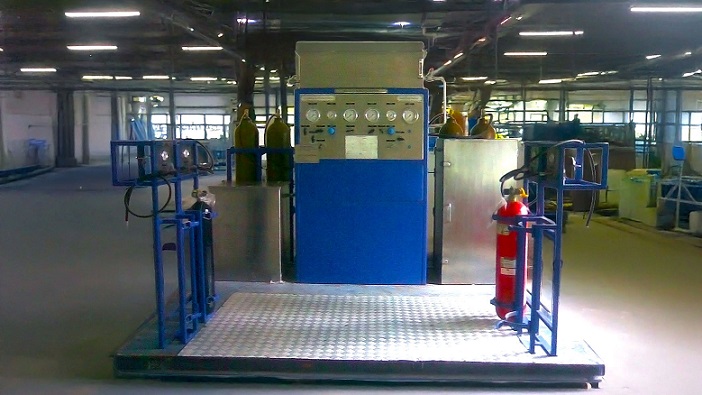
Neometrix Helium Charging Station
An all-in-one, skid-mounted unit for helicopter emergency helium bottle maintenance. Air-driven Haskel boosters handle both decanting (125 bar) and recharging (400 bar). Hydrostatic testing to 690 bar with water medium. Modular SS piping, multistage filtration, precision gauges, automatic safety cut-outs, and a control panel designed for single-operator sequential process management.
→ View Full Specifications
→ Request a Quote
FAQ
Q: Why is hydrostatic testing done to 690 bar when the working pressure is 400 bar?
A: Hydrostatic test pressure is set at 1.5–1.67× working pressure (depending on the applicable standard) to impose a proof load that verifies the bottle has adequate structural margin above its working pressure. At 400 bar working pressure, 690 bar test pressure corresponds to a 1.725× factor — slightly above the typical minimum, providing a conservative proof test margin. The hydrostatic test reveals any bottles with pre-existing defects (flaws in the cylinder wall, corrosion pitting, or damage from handling) that would not be apparent from visual inspection alone, and that could fail in service under fatigue or thermal cycling over the bottle’s remaining service life.
Q: What helium purity is required for helicopter emergency bottle recharging?
A: Emergency system helium typically requires Grade 5.0 or better (99.999% purity) to prevent contamination of valve components and regulator orifices with moisture or particulates that could cause unreliable actuation over the long storage periods between use. The multistage filtration in the Haskel-based charging system removes particulates before the helium reaches the bottle; the helium supply cylinders provide the initial purity level, which should be confirmed from the supplier’s certificate of analysis before use in flight-critical applications.
Neometrix Defence Ltd. manufactures helium charging stations for helicopter and aerospace emergency bottle maintenance. [email protected] | +91-7777-876-876