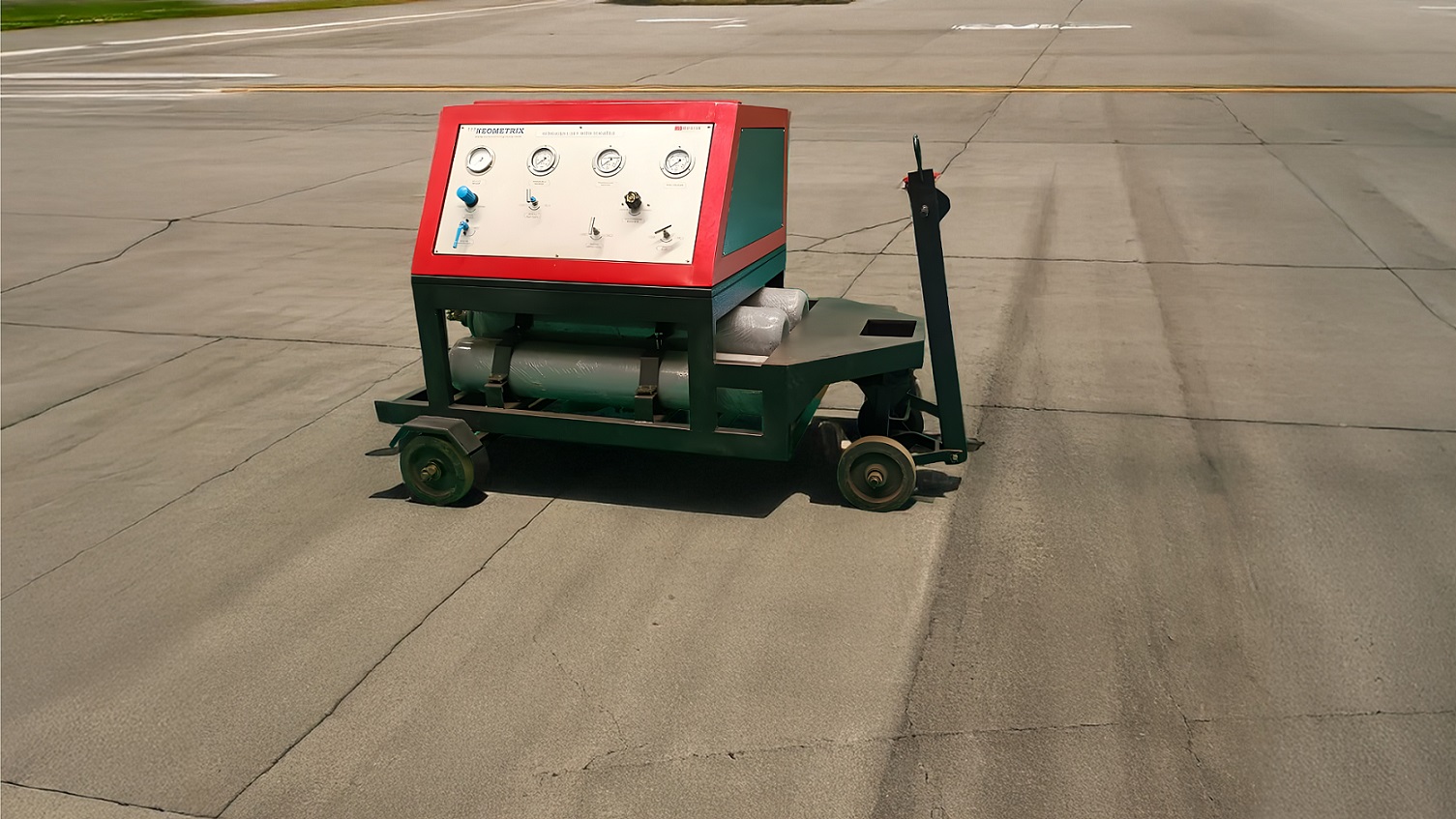

Aircraft landing gear struts, tyres, hydraulic accumulators, and pressurised systems require nitrogen — not air — for charging and servicing. Standard nitrogen cylinders deliver gas at cylinder pressure (up to ~200 bar as the cylinder empties), which is often insufficient to top up a strut or accumulator already at high pressure. A nitrogen booster amplifies cylinder pressure to the higher pressures required, without electricity, using compressed air as the drive gas.
A nitrogen cart with booster is the standard ground support equipment (GSE) for aircraft nitrogen servicing at ramp, hangar, and forward operating locations — providing high-pressure nitrogen delivery wherever it’s needed, with no electrical power required.
Why Nitrogen and Not Air?
Nitrogen is specified for aircraft systems for the same reasons it’s used in landing gear struts:
- Inert: doesn’t react with hydraulic fluid, rubber seals, or metal components
- Dry: no moisture to cause internal corrosion or ice formation at altitude
- No oxygen: eliminates fire/explosion risk in contact with hydraulic fluid under pressure
- Consistent: composition doesn’t vary like atmospheric air
MIL-PRF-27401 is the US military specification for nitrogen used in aircraft systems — specifying purity (99.5% minimum), moisture content, and oxygen content limits.
How a Nitrogen Booster Works
A nitrogen booster is an air-driven gas booster pump — a pressure amplifier that uses the force balance between a large-area air piston and a small-area gas piston to amplify gas pressure.
Amplification ratio: If the air piston area is 10× the gas piston area, and air is supplied at 10 bar, the nitrogen output pressure can reach 100 bar. For higher output pressures, multi-stage boosters are used.
The Neometrix specification: 415 kg/cm² (5,900 psi) output pressure from standard nitrogen cylinders — sufficient for:
- Aircraft tyre inflation (main gear tyres: 150–200 psi to 200+ psi)
- Landing gear strut charging (100–350 bar depending on aircraft type)
- Hydraulic accumulator charging (210–350 bar)
- Pressurised system purging and leak testing
No electrical power: The booster is driven entirely by compressed air — available from aircraft ground support compressed air supplies, a portable compressor, or the airbase compressed air network.
Applications
Aircraft tyre inflation: Nitrogen (not air) is specified for aircraft tyre inflation. Main gear tyres on transport aircraft operate at 180–220 psi; nose gear at 150–180 psi; fighter aircraft tyres at 300–400 psi. The nitrogen cart with booster provides the high-pressure supply needed from standard cylinders.
Landing gear strut charging: As described in the landing gear test rig context — oleo-pneumatic struts must be charged to AMM-specified pressure. For high-pressure applications (struts at 200–350 bar), standard cylinder pressure may be insufficient late in the cylinder’s life; the booster tops up to the required pressure regardless of cylinder residual pressure.
Hydraulic accumulator charging: Aircraft hydraulic systems use accumulators to store energy and dampen pressure fluctuations. Nitrogen-charged accumulators require periodic recharging to specification.
Inert gas purging: Fuel tanks, oxygen systems, and explosive-risk enclosures are purged with nitrogen to displace oxygen before maintenance. The cart provides a controlled flow for purging operations.
Forward military operations: The no-power-required design is essential for forward airbase operations where electrical infrastructure may be limited or unavailable.
International Standards
| Standard | Region | Application |
|---|---|---|
| MIL-PRF-27401 | USA/NATO | Nitrogen gas specification for aircraft systems |
| TO 42C-1-1 | USA | US Air Force technical order for nitrogen servicing |
| AMM Chapter 12 | Aircraft-specific | Servicing procedures per aircraft type |
| AMM Chapter 32 | Aircraft-specific | Landing gear nitrogen charging procedures |
| DEF STAN 91-073 | UK | UK MoD nitrogen specification |
| NATO STANAG 3170 | NATO | Interoperability standard for nitrogen servicing equipment |
Neometrix Nitrogen Cart with Booster
Air-powered nitrogen booster to 415 kg/cm² (5,900 psi). No electrical connection needed. Ideal for aircraft strut charging, tyre inflation, and inert purging at ramp and forward deployed locations.
→ View Full Specifications
→ Request a Quote
FAQ
Q: Why is nitrogen used instead of compressed air for aircraft tyre inflation?
A: Aircraft tyres are inflated with nitrogen because: (1) Nitrogen is dry — no moisture to cause corrosion on the wheel rim or bead seat. (2) Nitrogen doesn’t support combustion — aircraft tyres can reach high temperatures during heavy braking; oxygen in air creates a fire risk if the tyre bursts or valve fails. (3) Nitrogen pressure is more stable with temperature changes — nitrogen-inflated tyres show less pressure variation between cold and hot than air-inflated tyres (pure nitrogen has no water vapour to expand on heating). Most commercial airline operations and all military aviation specify nitrogen for tyre inflation.
Q: What is the maximum output pressure of the Neometrix nitrogen booster?
A: The Neometrix Nitrogen Cart with Booster delivers up to 415 kg/cm² (approximately 5,900 psi / 407 bar) output pressure — sufficient for virtually all aircraft landing gear strut charging, tyre inflation, and hydraulic accumulator charging applications. The booster is air-powered, requiring a standard compressed air supply (typically 6–10 bar) as the drive medium.
Q: What is MIL-PRF-27401 and does it matter for aircraft nitrogen servicing?
A: MIL-PRF-27401 is the US military specification for gaseous nitrogen used in aircraft systems. It specifies minimum purity (99.5% N2), maximum moisture content (dew point ≤ -40°C), and maximum oxygen content (<0.5%). Using nitrogen that doesn't meet MIL-PRF-27401 for aircraft system servicing can void maintenance records and create safety risks. For military aviation customers, nitrogen cylinder certification to MIL-PRF-27401 should be verified before use.
Q: Can the nitrogen cart be used for aircraft oxygen system purging?
A: Nitrogen purging is used to displace oxygen before maintenance on fuel systems and other oxygen-risk enclosures — but oxygen system purging requires careful procedures because residual nitrogen in an oxygen system creates a hypoxic hazard for breathing purposes. Oxygen system purging and refilling procedures must follow specific AMM instructions and are subject to strict safety controls. The nitrogen cart provides the nitrogen supply; the procedures must be followed exactly per the relevant AMM chapter.
Neometrix Defence Ltd. manufactures nitrogen carts with boosters for military and commercial aviation ground support. [email protected] | +91-7777-876-876